774-261-8484 (landline) ~ 294 West Boylston St. ~ 2nd. Floor ~ West Boylston, MA. 01583
Myofascial release vs deep tissue massage: Which is better for chronic pain?
The top reason clients come to my office is because they are dealing with chronic pain and limited joint mobility. Myofascial release vs deep tissue massage are the 2 most popular services I get questions about as far as what’s going to help someone feel better.
They are both quite different in their approach on how they help clients manage pain and soft tissue restrictions. It all really depends on the root cause of your pain and how long you have been dealing with your chronic discomfort. And it also matters how you respond to deep work. Sometimes soft tissue work that gets down through the deeper layers can flare up your symptoms.
I am going to go over in detail the benefits of both these popular services. And by the end you will be able to make an educated decision on which one is going to make you feel your best.
FeatureOil/lotion Clothing Focus Session Style Best for Pressure |
Myofascial ReleaseNo Workout clothes Fascia & restrictions Very focused Mobility restrictions Sustained pressure |
Deep Tissue MassageYes Undressed under sheet Muscles & tension Broader treatment area Muscle tightness Variable pressure |
What is fascia
Here is the definition of fascia. Network of connective tissue that envelops and supports the various structures and organs of the body, including the nerves, muscles, joints, tendons, and ligaments. The fascia serves an essential role in protecting and supporting the internal structures in the body, owing in particular to its ability to reduce friction between tissues and to transmit and distribute mechanical stress produced by external forces and muscle contraction.
When this connective tissue is healthy, it allows for smooth gliding of all the soft tissue over each other. But what happens due to an injury, poor body mechanics and inactivity. The fascia turns into super glue. These restrictions cause
- Chronic pain
- Limited joint mobility
- Muscle tightness
- Poor posture
- Headaches
- Joint discomfort
Fascia interconnects all of our soft tissue together. This can cause you to feel pain in multiple areas of the body at once.
What is myofascial release
Myofascial release's (MFR) main focus is loosening up the restrictions within the fascia and all the surrounding tissue. Your traditional massage uses a combination of gliding and kneading strokes with massage oil/lotion. MFR will use constant pressure with stretching in one area at a time to help to soften the fascia naturally.
During the health history intake we will go over what area(s) are bothering you the most. It is important to understand that MFR is not a full body treatment. A full body session is the Swedish massage. Once I understand what your goals are, during the actual session I can start feeling the restrictions in the fascia. There is no oil or lotion used and it is very detailed focused work. Common complaint clients see me for, neck pain. Generally that is an hour-long session. And the areas I usually work on are the upper back, shoulders and neck.
These are some of the common conditions I work with clients who have benefited from myofascial release
- Chronic neck pain
- Shoulder pain
- Back pain
- Plantar fasciitis
- TMJ dysfunction
- Tech neck
- Running injuries
Myofascial release helps with these types of situations because it is working on the connective tissue system rather than just muscle
What is deep tissue massage
Here is the definition of deep tissue massage. A type of massage in which the fingers, thumbs and elbows are used to release chronic muscle tension, using slow, deep strokes and friction; the therapist may work perpendicularly to the length of the fibers of the superficial muscles, with the intent of massaging muscle that lies underneath.
The goal is to help reduce muscle tension, improve blood flow and help to get normal movement patterns back. The techniques used are long slow strokes, trigger points and cross fiber friction.
Deep tissue massage can feel intense. But the pain levels should be tolerable. An effective session does not require a lot of force. A well educated massage therapist will be able to work within your pain tolerance, while relieving areas of chronic muscular pain. There is a lot of cross over to similar conditions that MFR helps with.
Key differences between myofascial release vs deep tissue massage
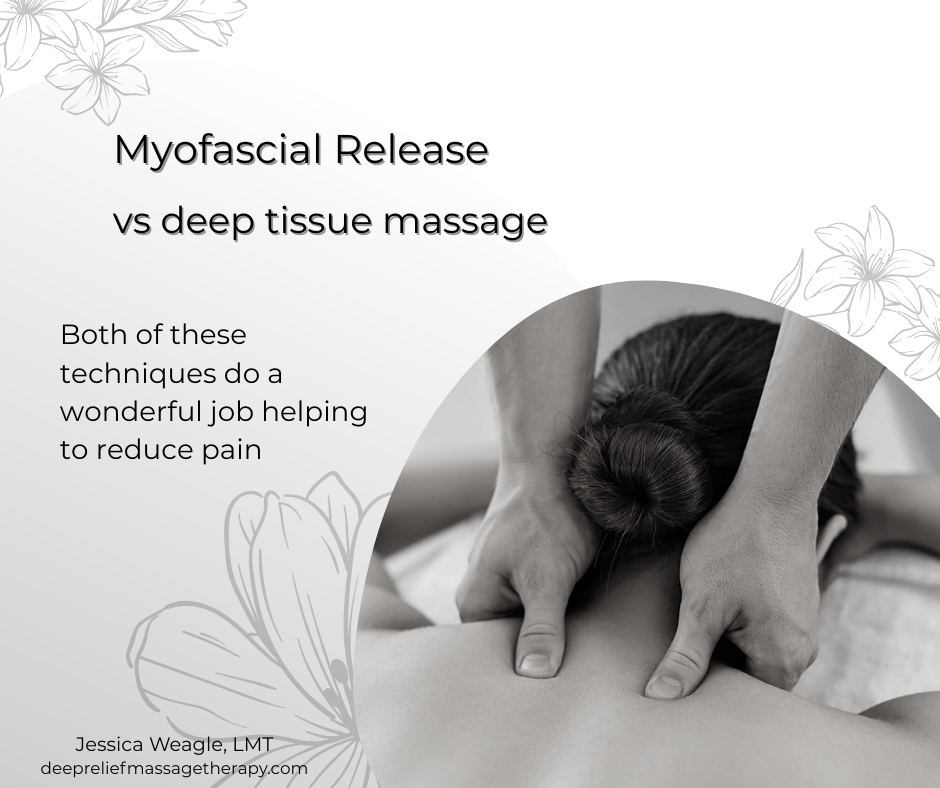
Both of these techniques do a wonderful job helping to reduce pain. Here are a few key differences between myofascial release vs deep tissue massage
Myofascial Release
|
Deep Tissue Massage
|
Which treatment is better for chronic pain
The best option for clients with chronic pain depends on personal choice when it comes to bodywork. Here are some key points to keep in mind. This is my top question I ask clients. “How do you respond to deep work?” The answer to this question helps me guide you to the best answer.
With myofascial release it is a clothed service mostly. Clients need to have on workout shorts and women need a sports bra. This is because I may need to have you change positions on the table quite a bit. How much depends on what I find as far as fascial restrictions. There is no oil or lotion used. And the area I work in most of the time is small. Here is an example. Clients dealing with plantar fasciitis. That is an hour-long session and it is knee down front and back.
Deep tissue massage in my opinion can give you similar results. Here are session differences to understand. Oil and lotion are used. Clients do get undressed. The area I work in for chronic pain is going to be bigger. You can check out my other blog post about Benefits of Deep Tissue Massage. It is more working on getting the muscles to relax and increasing blood flow to those areas of restriction.
Can these two services be combined? Sort of. The myofascial release needs to be done first. Once I add massage oil to my hands I lose my ability to get a firm enough grip on the fascia. What I usually suggest to clients is, let me know what area of pain you would like me to focus on for the myofascial release portion and the rest of the time can be a more traditional massage. Just keep in mind that your session may need to be 90 minutes if you would like to have both services done at the same time
How many sessions will I need
The amount of sessions you will need is going to greatly depend on how long the pain has been going on, and your pain level. I have another article I wrote How Often Should I get a Massage, if you are looking for a more detailed answer. Here are my general guidelines I share with clients. Acute chronic pain is a weekly session. Pain is tolerable and are starting to get function back is bi-weekly. Maintenance is 4-6 weeks. How long it takes you to get to maintenance just depends on how quickly your nervous system responds to massage therapy.
FAQ myofascial release vs deep tissue massage
Is deep tissue massage good for chronic pain?
Is deep tissue massage good for chronic pain?
Yes it is! I have many clients I see on a regular basis for pain management
How often should I get myofascial release treatments?
How often should I get myofascial release treatments?
It depends on how chronic your pain is. If your pain is acute, then I suggest weekly sessions
Does myofascial release hurt?
Does myofascial release hurt?
It can be uncomfortable. I like to tell clients to keep the pain more more than a 6-7 on their pain scale.
Is myofascial release better than deep tissue massage?
Is myofascial release better than deep tissue massage?
No. They both help clients with their pain. It is just personal preference
Where can I get myofascial release in Central Massachusetts?
Where can I get myofascial release in Central Massachusetts?
My office Deep Relief Massage Therapy is located on RT.12 in West Boylston, MA.
I got certified in myofascial release back in 2012 by Howard Rontal. I took all 3 of his course plus the certification test. If you are in the Central Massachusetts area and are looking for either myofasical release or deep tissue massage for you chronic pain, I am always taking on new clients. You can easily book your next session with me online